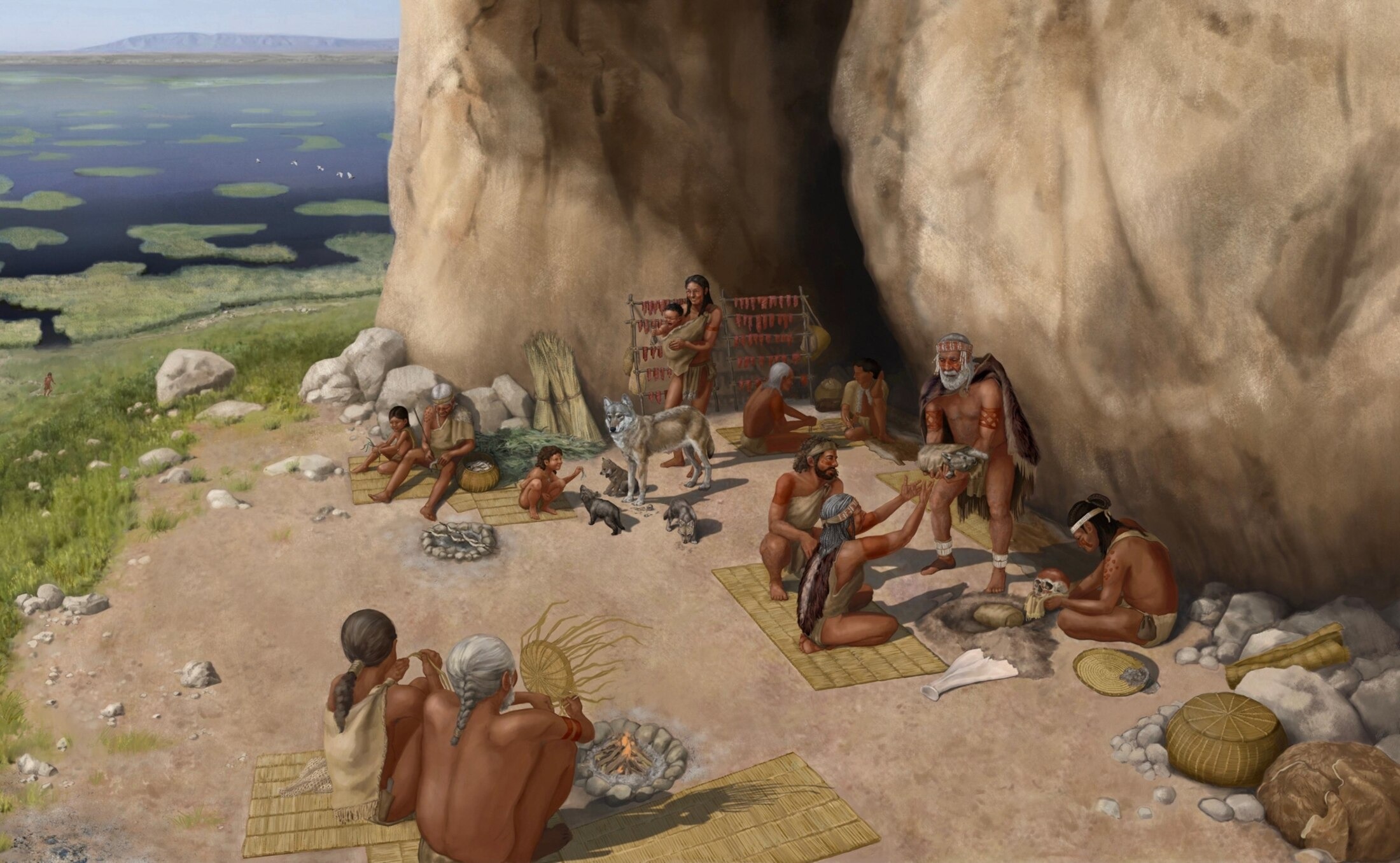
 Image: Kathryn Killackey
An artist’s reconstruction of life at Pınarbaşı. This is an artistic reconstruction, not a photograph of the ancient site.
Before the first farms
Dogs are an unusual domestic animal because their history with people reaches back before the agricultural world that produced sheep pens and grain stores. That makes the earliest part of the story difficult to read. Hunter-gatherers moved through landscapes where wolves also lived, and the surviving evidence is often a tooth, part of a jaw or a damaged bone. A canine found near a human site is an important clue, but proximity alone cannot tell us whether it was a companion, prey or a wild visitor.
A genetic foothold in the Ice Age
One of the new studies recovered nuclear and mitochondrial genetic evidence from canine remains at Pınarbaşı in Türkiye, dated to about 15,800 years ago, and Gough’s Cave in Britain, about 14,300 years ago, alongside younger material from Serbia. The results identify dogs rather than simply dog-shaped wolves. They also show that related dogs were already spread widely across Europe and Anatolia by the later part of the Ice Age. This is a minimum age for an established relationship, not proof that domestication began at either excavation site. Read the Nature study.
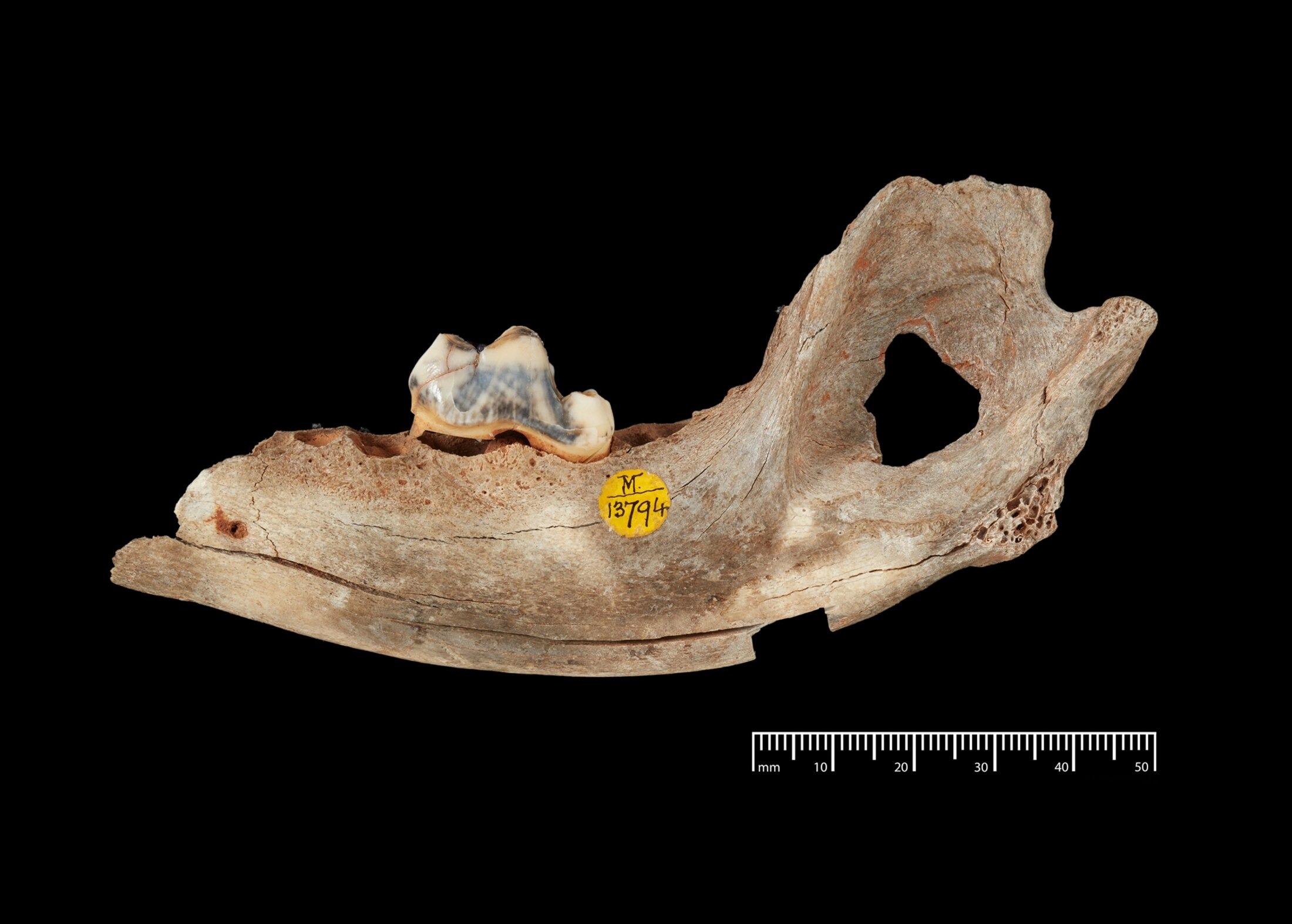 Photo: Trustees of the Natural History Museum, London
DNA from a roughly 14,300-year-old dog at Gough’s Cave helped establish the presence of an already widespread dog lineage in Ice Age western Eurasia.
Europe’s dogs were not an isolated invention
A second team screened ancient canid remains from 216 samples, concentrating on Europe before farming. Its oldest recovered dog genome came from Kesslerloch in Switzerland and was about 14,200 years old. That animal shared ancestry with later dogs elsewhere in the world, undermining a simple picture in which Ice Age European dogs were an entirely separate domestication that vanished without a trace. The evidence instead points toward connections within a broader dog history. Explore the companion genetic study.
Human migrations did not copy themselves exactly
When farming populations entered Europe, they brought major changes in human ancestry. The canine story was not a perfect duplicate. The genetic analysis found incoming Southwest Asian ancestry in dogs, but also substantial continuity with the continent’s earlier dog populations. People moving into a landscape could incorporate dogs already living there, rather than replace every local animal with companions of their own. Dog DNA can therefore reveal connections between communities while also showing that animals had their own patterns of movement and mixing.
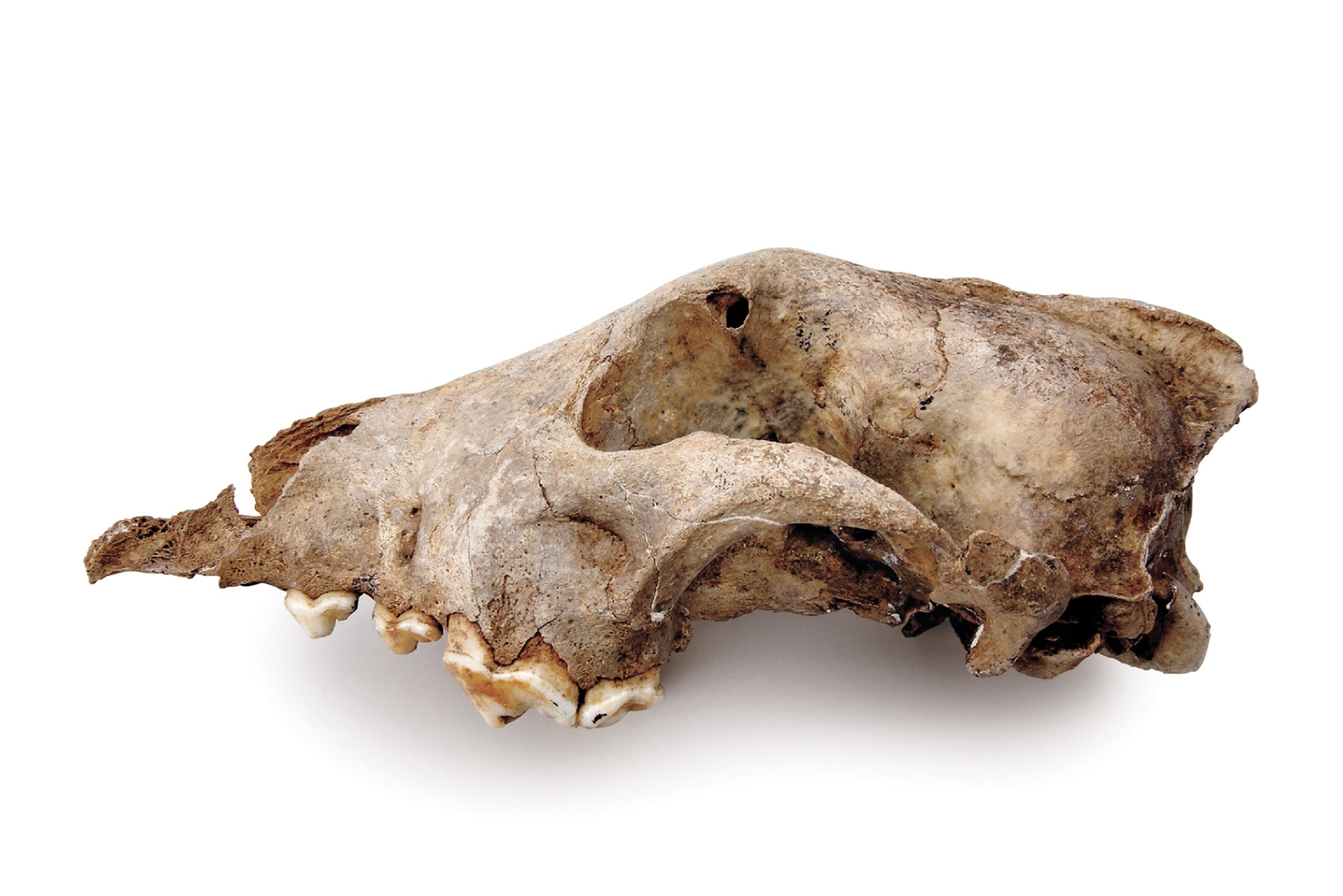 Photo: Royal Belgian Institute of Natural Sciences
This is a modern dog skull, not the ancient Goyet specimen. Shape can help researchers ask questions, but ancient DNA is crucial when a fragment could belong to either a dog or a wolf.
Why a skull cannot settle everything
Early dogs and wolves overlap in size and shape, and researchers do not always agree about which features make an ancient specimen domestic. Genetics supplies another line of evidence, but preservation is uneven and the available bones are only a tiny sample of once-living animals. A date based on one securely identified genome tells us what existed by that time; it cannot reveal the first pup born into a changing relationship with people. Oxford’s research overview explains the discovery.
The beginning is still somewhere beyond the record
Earlier research comparing 72 ancient wolf genomes found that dogs were generally more closely related to ancient eastern Eurasian wolves, while some dog populations also carried ancestry related to southwestern wolves. None of those sampled wolves was an exact match for the ancestral populations sought. That leaves room for a more complicated process of separation and later mixing, rather than a tidy story of one place, one encounter and one sudden transformation. Read the earlier wolf-genome research.
What the new record makes vivid is the depth of the connection. By the time these Ice Age dogs left their bones behind, the relationship was already geographically extensive. The couch, leash and familiar modern breed are recent chapters. The shared history underneath them is much older—and still being pieced together.